
When we talk about retirement saving, we almost always start with the same assumption: you first get a job, and then you start saving for retirement. But why?
Why should retirement saving begin at 25, 30 or even 40, when the most powerful ingredient in long-term investing is not necessarily how much you save, but how long your money has to compound? Imagine opening a pension account for a child at birth. Suddenly, we are not talking about a 30- or 40-year investment horizon. We are talking about 65 or 70 years.
And when it comes to compound interest, those extra decades can make an extraordinary difference.
Take a simple example. Imagine investing €1,000 for a child at birth and then putting aside just €50 a month. The child grows up with the account and simply continues the habit. At age 40, when earnings will hopefully be higher, the monthly contribution increases to €100. Assuming an average annual return of 8%, by age 65 the account could be worth more than €1.3 million.
The remarkable part? Over those 65 years, only €55,000 would actually have been contributed. The rest of almost €1.3 million would come from investment growth and the extraordinary power of compounding over such a long period.
Of course, an 8% average annual return over 65 years is an assumption, not a promise. Real markets are volatile, returns do not arrive in a straight line, and fees, taxes and inflation matter. We have also deliberately kept the contributions fixed in nominal terms, ignoring the fact that they would likely increase over time at least in line with inflation. The main point here is time. When saving for retirement, we spend enormous amounts of effort discussing how much people should save, where to invest and so on. Perhaps we should spend more time asking another question: How early can we get them started?
Some countries are beginning to think differently
The idea of investing for retirement from childhood may sound unusual, but it is becoming much less theoretical.In the United Kingdom, parents can already open a Junior SIPP — a Self-Invested Personal Pension — for a child. Even if the child has no earnings, parents can contribute up to £2,880 a year, with the government adding a further £720 in tax relief, bringing the total to £3,600. Investment income and capital gains within the Junior SIPP are also free from UK income and capital gains tax. The account is opened and managed by a parent or guardian until the child turns 18.
The Junior SIPP is a proper retirement savings vehicle and can only be accessed at retirement age, so the child cannot simply take it out at 18 to buy a car or travel around the world. But that is exactly the point of dedicated retirement saving. [1]
Across the Atlantic, the United States has gone a step further with the newly introduced Trump Accounts (also known as Section 530A Accounts).
These are tax-advantaged investment accounts for children under 18. For eligible US children born between 2025 and 2028, the federal government provides a one-time $1,000 contribution. In addition, some philanthropic donors have pledged supplemental contributions for eligible children. And from a few days ago parents don`t even have to open the account as more than 60 million children have been auto enrolled and their accounts created automatically bringing a total number of Trump Accounts to almost 70 million. Parents now only have to claim the account by downloading the special app and completing the identification procedures.

Once the account is opened families and others can contribute, with most contributions subject to an annual $5,000 limit, and even employers of parents can contribute up to $2,500 annually, now that’s something. During childhood, investments are generally restricted to low-cost index funds tracking primarily US companies. When the child reaches age 18, the account continues as a traditional IRA and is generally governed by the normal IRA rules. [2]
And now Europe has an especially interesting example from Germany.
In August 2026, the German government approved a draft law introducing the Frühstartrente, literally an “early-start pension”.
Under the proposal, the government would contribute €10 per month from age six until 18 into a funded retirement account in the child’s name. Parents and grandparents could add their own contributions. The accumulated government-supported retirement assets would generally remain invested until at least age 65.
The German Finance Ministry makes the reasoning remarkably clear: start investing early, allow compounding to work for decades and, at the same time, teach children how long-term investing works. [3]
That last point may actually be just as important as the money.
Parents start. Children continue.
One of the biggest problems in retirement saving is getting people to start. Retirement is distant. The benefits of saving today are abstract. There is always something more immediate competing for our money. Behavioral economics has taught us that procrastination, present bias and inertia are formidable enemies of retirement saving and I have written many articles on these topics on this blog.
But inertia can also work in our favour. Imagine reaching your first job at 23 and discovering that you already have a pension account. Your parents have been contributing to it for years. You have watched it grow. Perhaps you received an annual statement, followed the investments and learned why markets sometimes go down as well as up.
The question is no longer:
“Should I start saving for retirement?”
It becomes:
“Should I continue what has already been started for me?”
That is a very different proposition.
The parent makes the difficult first decision. The child inherits not only the accumulated assets, but also a default behaviour: I am someone who saves for retirement – a saver or an investor. That is a totally different spin. Over time, that could be more valuable than the original contributions themselves.
There is also a financial-literacy dimension. Instead of teaching compound interest as an abstract equation in school, a teenager could see it happening in his or her own account and national financial literacy campaigns could use this as a concrete example, why not use it as a good example to teach compound interest in math class. A market decline becomes a lesson about volatility. A dividend becomes a lesson about ownership. Ten years of accumulated returns become a lesson about compounding. Retirement saving stops being something that suddenly appears on a payslip when you get your first job. It becomes part of growing up financially.
Why not Slovenia?
I recently argued in European Pensions [4] that Slovenia could implement something similar with an almost surprisingly simple legislative change. Today, Article 215 of Slovenia’s Pension and Disability Insurance Act essentially limits participation in supplementary pension saving to people already covered by mandatory pension insurance or beneficiaries of those rights. That means parents cannot simply open an existing supplementary pension account for their child. Yet all of the infrastructure is already there.
Slovenia has regulated supplementary pension funds, professional asset management, life-cycle investing, tax incentives and more than two decades of experience with funded supplementary pensions.
We would not necessarily need to invent a new “Junior Pension”. We could simply allow parents to open an existing supplementary pension account in their child’s name. Parents could contribute during childhood. Grandparents could contribute instead of — or alongside — another birthday present. And if the government would pay some additional starting contributions like in the US, let’s say 1.000 € for every newly opened account, now that would really give a boost to this form of saving. And 1.000 € is not a lot, in Slovenia in the last years you could receive a subsidy in the range of a few thousand euros when purchasing a new electric vehicle all the way up to 7.000 €, so asking for 1.000 € to promote pension saving is not asking for much. And the money will be invested in the capital markets not thrown away.
Once the young person enters employment, he or she could simply continue contributing to the same account, potentially joined by employer contributions. The account could therefore accompany someone from birth to retirement.
And I can tell you from first hand experience working in a Slovene pension fund that we receive many calls and emails from parents wishing to open a retirement savings account for their children, which we unfortunately have to turn down due to inappropriate legislation that does not promote saving in this way, which is a shame.
From a policy perspective, this would also support the broader goals of the European Commission’s Savings and Investments Union initiative, which aims to mobilise household savings into capital markets across the EU. Pension funds are natural long-term investors, and every additional euro invested strengthens both domestic and European capital markets. [5]
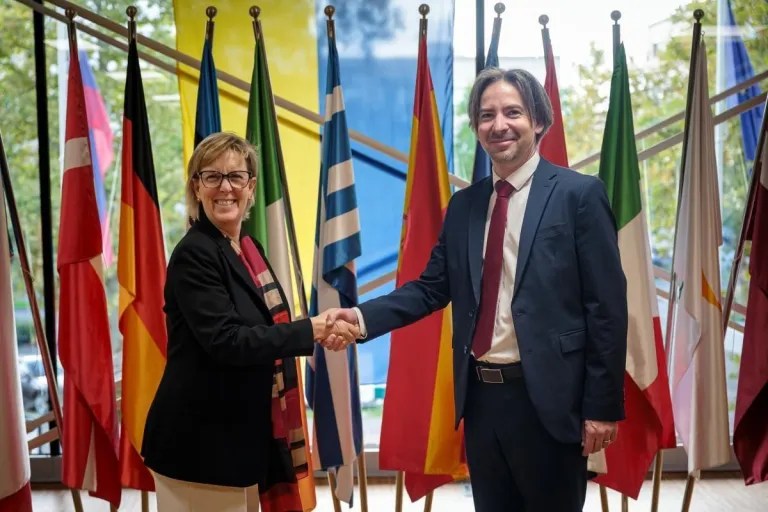
I was honoured to meet last year the European Commissioner for Financial Services and the Savings and Investments Union, Maria Luís Albuquerque. We discussed the Commission’s strategy for strengthening capital markets and what role could the pension funds play.
Perhaps retirement saving should begin at birth
There are legitimate questions around tax incentives, contribution limits, access to the money, investment choices and whether governments should subsidise accounts. Those are all valid questions, but they should not distract us from the much simpler underlying idea.
We spend enormous amounts of time trying to persuade adults to start saving earlier. We design calculators, tax incentives, communication campaigns, nudges and automatic-enrolment systems to overcome procrastination. Perhaps we should also ask a more radical question:
What if, by the time people enter the workforce, starting was already behind them?
Parents could start the journey. Children could grow up with the account, learn from it and eventually take responsibility for it themselves. The greatest advantage would not only be another 20+ years of compound returns. It could be another 20+ years of building the habit of being a long-term investor. And as the example at the beginning of this article shows, when you give compounding 65 or even 70 years to work its magic, the results can truly be extraordinary.
Žiga Vižintin
Further reading:
[1] Unbiased – Junior pensions: what is a junior SIPP and how does it work? and Hargreaves Lansdown – Junior SIPP.
[2] SEC Investor.gov – Trump Accounts, The White House – Trump Accounts Put 70 Million Kids on the Path to Financial Freedom and U.S. Department of the Treasury – Completion of Automatic Enrollment for Trump Accounts.
[3] German Federal Ministry of Finance – Frühstartrente: Questions and Answers and German Federal Ministry of Finance – Cabinet Approves Early-Start Pension Draft Law (12 August 2026)
[4] European Pensions: Guest Comment: Parents saving for their children’s pensions – a simple legislative fix for Slovenia?
[5] European Commission: Savings and investments union: better financial opportunities for EU citizens and businesses and European Council: Savings and investments union.

